What makes Plastazote® different
Most polyethylene foams are expanded with chemical blowing agents. Zotefoams expands Plastazote® with pure nitrogen in an autoclave, so the foam carries no blowing-agent residues and a very uniform closed-cell structure. The result is high purity (useful for medical, food and optical packaging), consistent density and properties from block to block, and good dimensional stability for precision CNC work.
Properties
| Property | Plastazote® LD45 | Notes |
|---|---|---|
| Density | 2.8 lb/ft³ (45 kg/m³) | Lower (LD29) and higher (HD) densities exist for softer cushioning or firmer inserts |
| CFD @ 25% | ~13.6 psi (94 kPa) | Firmer than PU, much lighter than sponge rubber |
| Continuous temperature | −70 to +105°C | Thermoformable above its softening point |
| Water absorption | Very low (closed-cell) | Buoyant; suitable for marine and wet environments |
| Chemical resistance | Good | Resists most acids, alkalis and oils |
| Fire | FR grades: FMVSS 302, FAR 25.853 | Standard grades are not flame retardant |
| Raw sheet | $0.75–$2.50/ft² (1/4"–1/2"); $3.00–$6.00 (1"–2") | Indicative |
Converting rules
CNC routing
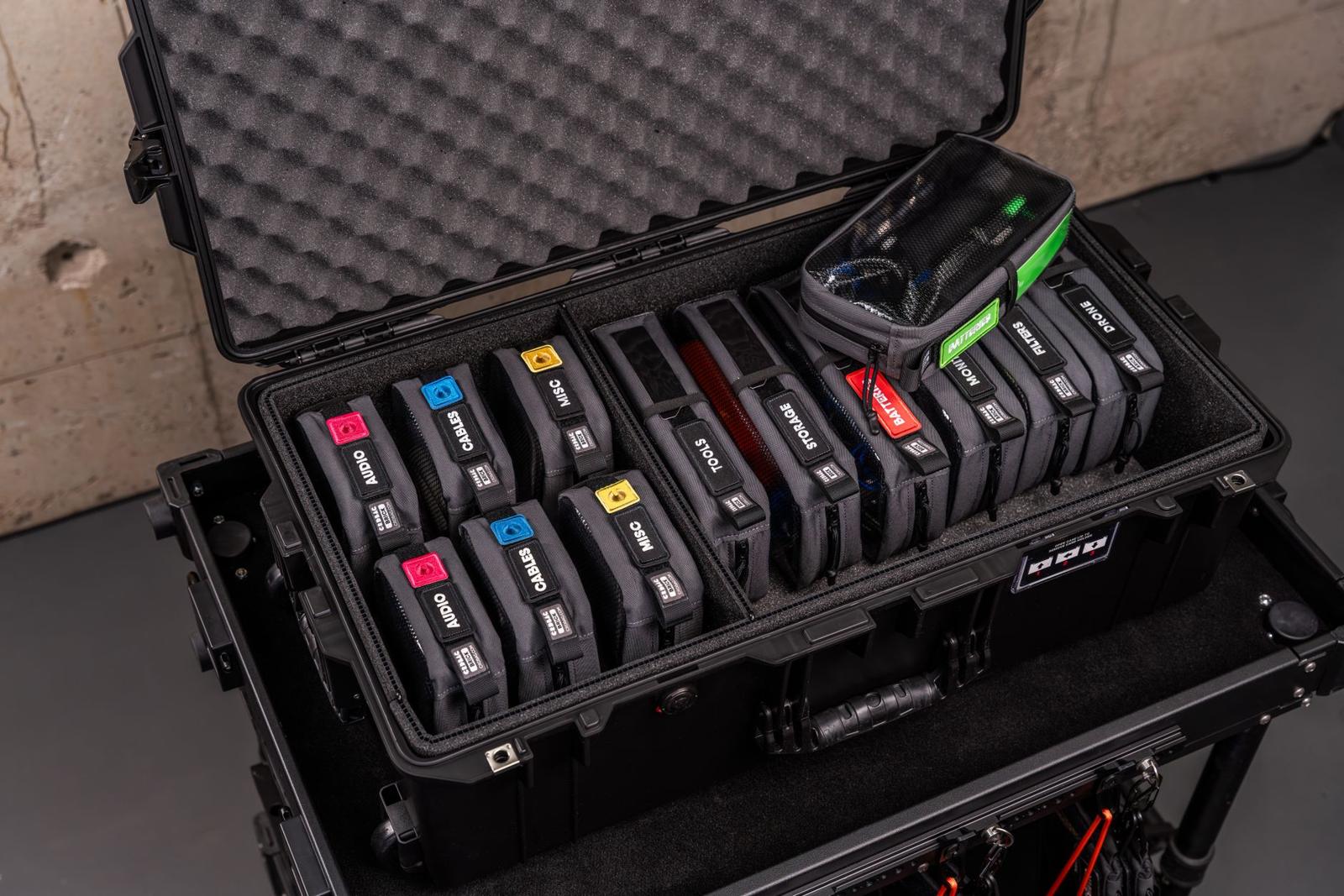
The usual process for case inserts. XLPE routes cleanly with sharp single-flute tools; multi-depth pockets, finger cutouts and chamfers come from one block. Expect ±0.030"–±0.060" on pocket dimensions. Two-colour laminates (a thin bright layer under a dark top layer) make missing tools obvious on shadow boards.
Waterjet
Best for tight 2D profiles and for cutting individual layers that are later laminated into a stepped insert; square edges at 2" and more.
Die cutting
Fine for thin XLPE gaskets and pads up to roughly 1/2"; thicker blocks dish under the rule.
Thermoforming and heat welding
Cross-linked PE can be thermoformed into trays and heat-welded to itself, joining layers without adhesive where outgassing or chemical cleanliness matters.
Adhesive: XLPE is a low-surface-energy substrate. Use 3M 9474LE (300LSE) or another LSE-rated adhesive. Standard 200MP acrylics (467MP / 468MP) peel off. See PSA lamination.
Case inserts and packaging specifications
MIL-PRF-26514 is a polyurethane cushioning specification, so it does not apply to XLPE. For XLPE inserts the drawing normally calls out the material grade and density, the pocket depths, and, for shock protection, a design drop height backed by the manufacturer's cushion curves. For electronics, use a static-dissipative or conductive XLPE (see ESD foams).
Plastazote® or EVA?
EVA foams are rubberier, tougher on the surface and come in brighter colours, which suits tool-control boards that see daily handling. Plastazote® is cleaner, lighter and more consistent for precision and medical packaging. Both price similarly at moderate thickness; the estimator includes both.