Basotect® melamine foam
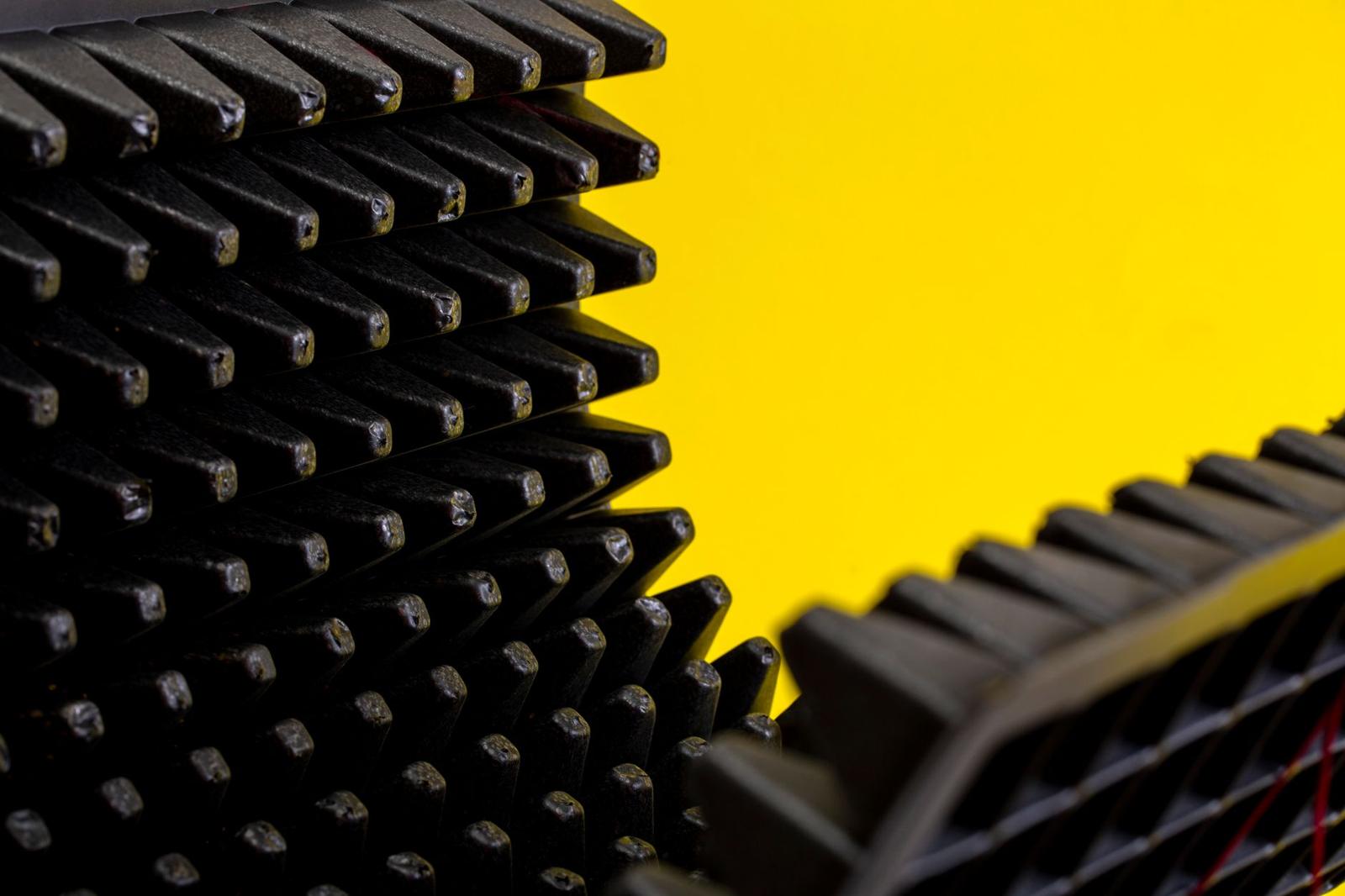
BASF Basotect® is an open-cell foam made from melamine resin. Its fine, thin-strut network absorbs mid and high frequency sound efficiently at very low weight, and the melamine chemistry is inherently flame resistant without added flame retardants.
| Property | Basotect® G+ / UL |
|---|---|
| Density | 0.56 lb/ft³ (9 kg/m³) |
| Compression stress (ISO 3386-1) | >7 kPa (>1.0 psi) |
| Temperature range | −200 to +240°C |
| Flammability | UL 94 V-0 and HF-1, FMVSS 302 (SE), FAR 25.853 on the UL grade |
| Cell structure | Open-cell, absorbs water (not a seal) |
| Raw sheet | $1.50–$3.50/ft² (1" / 25 mm); $3.00–$7.00 (2" / 50 mm) |
Where it is used
- HVAC and air-handling unit liners, appliance and compressor enclosures;
- aircraft and rail interior insulation (FAR 25.853 on the UL grade);
- electronics and generator enclosures that need both acoustic absorption and a V-0 rating;
- high-temperature thermal insulation where polyurethane would char.
Converting notes
Melamine is brittle in thin sections and abrasive to knives. Waterjet and CNC give the cleanest edges on thick absorbers; die cutting works for flat panels with generous radii. It is commonly faced with aluminium foil or a PET film for cleanability, laminated with 3M 467MP for mounting.
ESD foams
Electronics handling and packaging programs run to ANSI/ESD S20.20 (the control program) and ANSI/ESD S541 (packaging). Foams fall into two resistance bands:
| Type | Surface resistance | Use |
|---|---|---|
| Conductive | 10³–10⁵ Ω | Shunting IC leads, inserts that must hold devices at one potential |
| Static dissipative | 10⁶–10¹¹ Ω | General handling trays and packaging, slower charge bleed-off |
| Insulative | > 10¹¹ Ω | Not ESD-safe; avoid near sensitive devices |
Materials
- Conductive XLPE: carbon-loaded cross-linked polyethylene, closed-cell, 2.0–4.0 lb/ft³, CFD 6–14 psi. Routed or waterjet-cut into trays and case inserts; durable and non-sloughing.
- Conductive PU: carbon-impregnated open-cell polyurethane, CFD 0.5–2 psi. Soft cushioning for lightweight boards; can shed carbon over time.
- Dissipative (pink) PE: antistatic additive, lower cost, for general packaging.
Conductive XLPE is a low-surface-energy foam: bond it with 3M 9474LE. Carbon-loaded foams vary by supplier, so we supply resistance data from the manufacturer for each lot on request.
Indicative raw sheet cost for ESD foams is $1.80–$4.80/ft² (1/4"–1"). Compare process costs for an ESD tray in the conversion cost estimator.